



Webinar: Which AI Tool Is Right for Each Task?
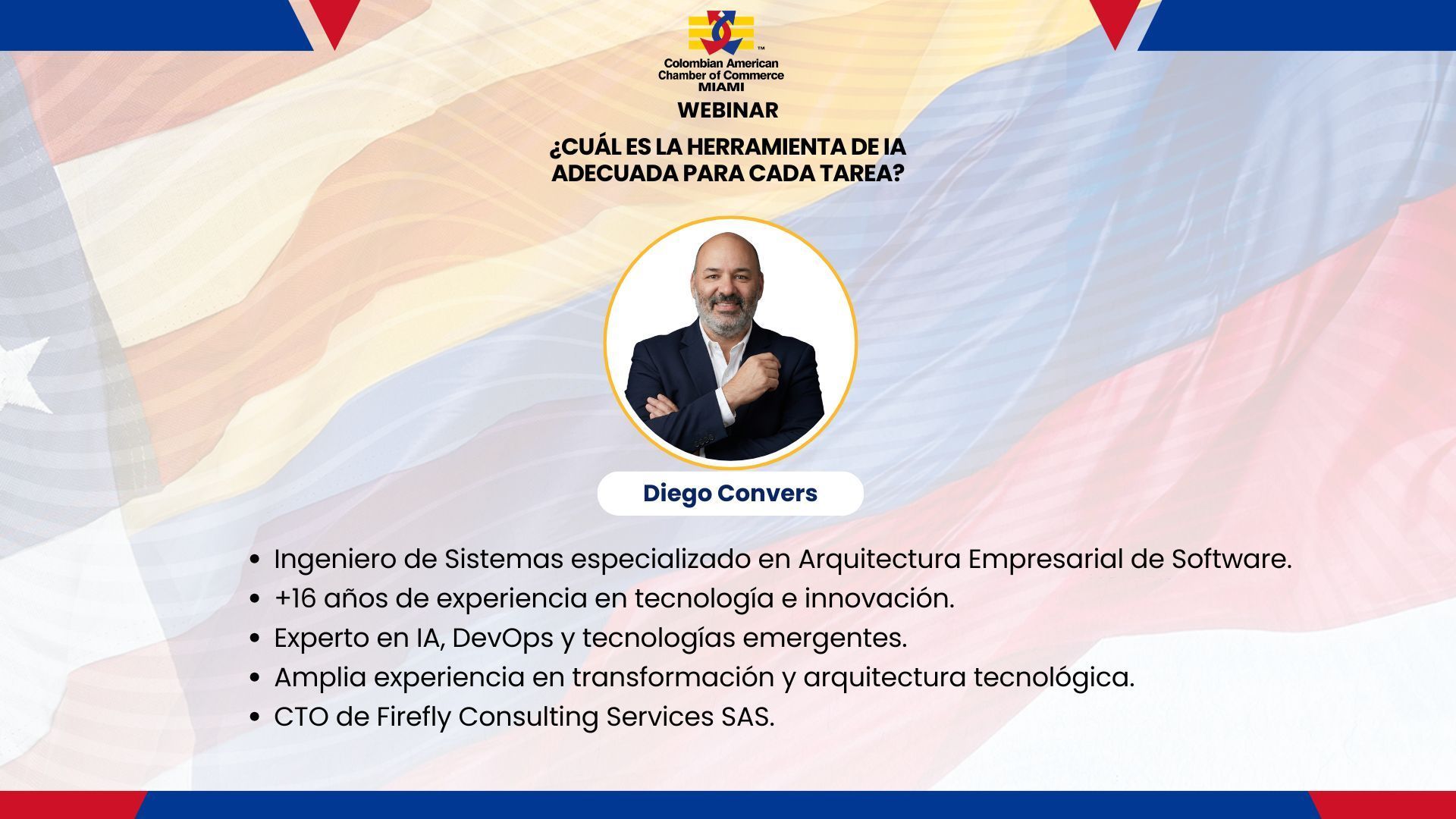


Last Tuesday, August 4, the virtual event "Which AI Tool Is Right for Each Task?" brought together professionals interested in driving the strategic adoption of artificial intelligence across the business community. Organized by the Colombian American Chamber of Commerce Miami, the event served as a high-value platform for organizations seeking to optimize processes, reduce operational time, and sustainably strengthen their competitive advantage.
From AI Trends to Real Productivity
The session opened with welcoming remarks from Valentina Otero, representing the Chamber, who introduced the organization's member company, Firefly Software Consulting. The featured speaker was Diego Convers, Chief Technology Officer (CTO) at Firefly, a technology leader with more than 16 years of experience in software architecture, DevOps, and digital innovation.
Throughout his presentation, Convers emphasized the importance of approaching Artificial Intelligence from a practical, user-centered perspective. Rather than focusing on the mathematical complexity behind AI models or data science algorithms, the session explored how professionals across industries—including accounting, education, engineering, and other sectors—can leverage existing AI technologies to improve their daily workflows and increase operational efficiency.
Key Concepts for Making Better AI Decisions
To help organizations make cost-effective technology decisions, Convers recommended developing a foundational understanding of Large Language Models (LLMs). He highlighted three essential concepts:
- Parameters: The number of parameters determines a model's reasoning capabilities and directly influences the hardware resources required to run it.
- Tokens: Tokens are the units used to measure both input and output text. They also serve as the basis for calculating processing costs when integrating AI models through APIs.
- Context Window: Often described as the model's short-term memory, the context window determines how much information the model can process at once and has a significant impact on memory usage, particularly when running AI locally.
Understanding these technical differences is critical when deciding whether an organization should deploy edge models—which operate locally and offline on optimized computers or mobile devices—or frontier models, powerful cloud-based systems designed to perform highly sophisticated analytical tasks.
Mapping AI Solutions to Business Use Cases
One of the session's key takeaways was a practical framework for selecting AI solutions based on specific business needs:
- Search and Advisory AI: Natural language tools designed to accelerate information retrieval and enable rapid analysis of technical documents.
- Generative AI: Platforms focused on creating visual assets, multimedia content, and creative materials that enhance corporate communications and marketing initiatives.
- Productivity AI: AI assistants natively integrated into email platforms, calendars, and cloud-based productivity suites—such as Google Workspace with Gemini and Microsoft 365 Copilot. These solutions streamline meeting summaries, analyze large volumes of résumés, automate document management, and generate daily email digests.
- AI for Code Generation: Tools that support both experienced software developers and non-technical professionals by accelerating the creation of interactive reports, internal applications, and local data portals.
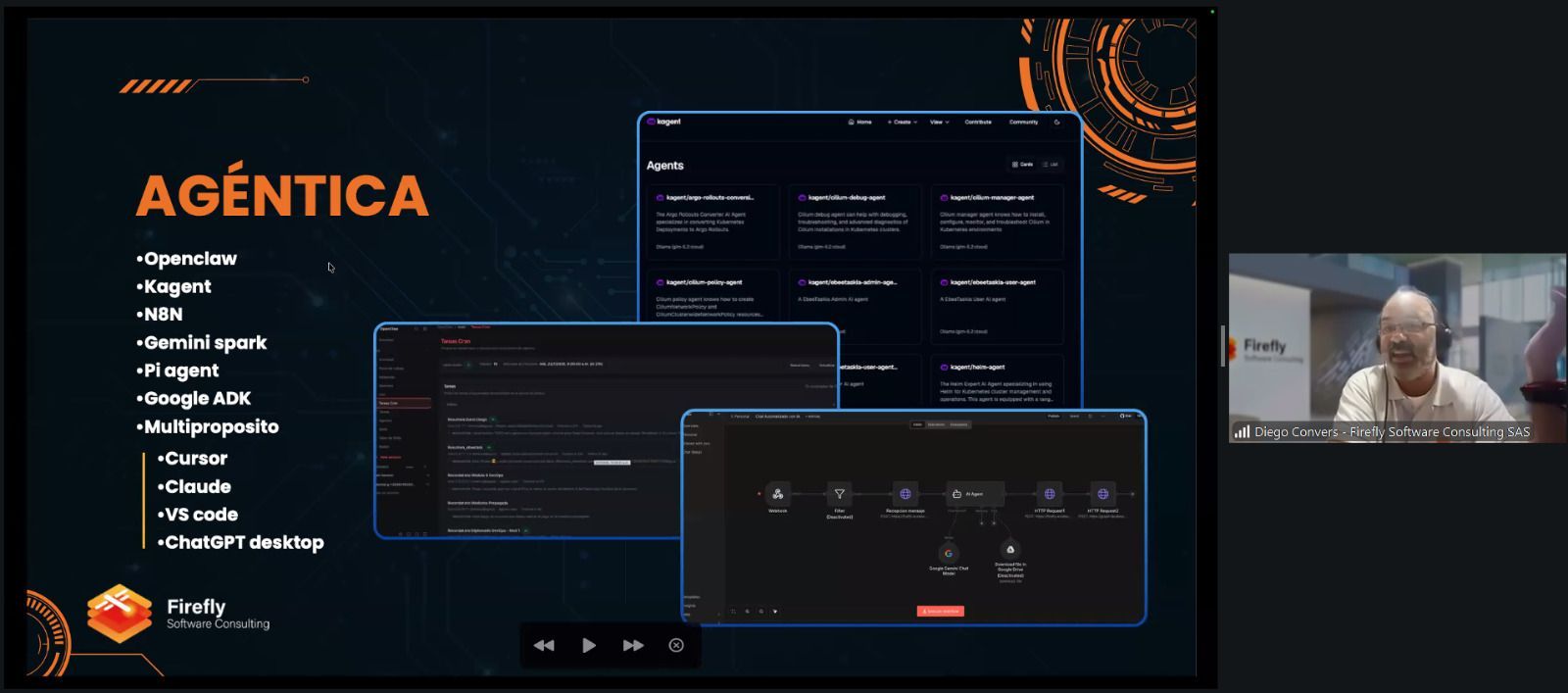
The presentation also explored the growing capabilities of autonomous AI agents, which can execute goal-oriented workflows within enterprise systems such as CRM and ERP platforms using standardized protocols like Model Context Protocol (MCP). Convers stressed that, despite these advances, human oversight remains essential to validate each stage of the process and ensure reliable outcomes.
The Path Toward Digital Maturity
The session concluded with a strategic reflection on technology adoption. Diego Convers emphasized that implementing AI should never be driven by trends or the desire to project a modern corporate image. Instead, organizations should first optimize and standardize their internal processes before introducing automation that addresses measurable business challenges and delivers tangible value.
To support companies on this journey, Firefly Software Consulting introduced a complimentary Digital Maturity Assessment, designed to help organizations evaluate their current technological capabilities and develop a customized roadmap for implementing AI solutions that drive long-term productivity and sustainable growth. impulsen su productividad a largo plazo. Check it here.
The Colombian American Chamber of Commerce Miami invites the entire business community to continue participating in upcoming events and to take advantage of these opportunities for meaningful dialogue, professional networking, and knowledge sharing. Through these conversations, business leaders can broaden their perspectives, learn from real-world experiences, and make more informed decisions as they navigate the evolving landscape of artificial intelligence and digital transformation.
Visit the Events Calendar to stay up to date with our upcoming events.